
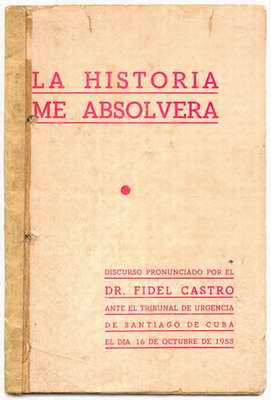
 Guantanamo.- On October 16, 1953, a historic event took place in the nurses’ ward of the Saturnino Lora Civil Hospital in Santiago de Cuba. The principles set forth in the manifestos of La Demajagua (1868) and Montecristi (1895)—the foundational programs of Cuba’s revolutionary tradition—converged there.
This time, however, they did not emerge from the wilderness of armed struggle, but through Fidel’s powerful voice as he delivered a self-defense speech intended to redeem and vindicate a violated nation.
Half a century of neocolonial rule had made the constant threat of eviction a daily reality for small farmers, while the country’s best lands had been seized by foreign companies.
Four hundred thousand families lived in overcrowded conditions, while countless others were completely homeless. More than one million people were illiterate, and another million were unemployed—all in a country with virtually no industry and woefully inadequate healthcare services.
When “it seemed that the Apostle [José Martí] was going to die in the year of his centenary—that his memory would be extinguished forever,” Cuba refused to allow it. Some of the nation’s finest sons rose up, justified by history and supported by the people. Inspired by the legacy of Céspedes and the spirit of Martí, that generation overthrew the dictatorship, ended the country’s subservience to foreign interests, and brought to fruition the vision of a nation “with everyone and for the good of everyone.”
The Moncada Program charted a path toward making farmers the owners of the land they worked. It called for rent reductions and housing-construction plans—so that Cuba could eradicate illiteracy and make guaranteed employment more than a mere utopian ideal; so that industrialization could begin and, even in the most remote areas, every community could have a doctor, a nurse, and a healthcare facility. These achievements have even been acknowledged and held up as examples by international organizations.
Our Commander in Chief always understood that the Revolution would continue after its triumph and that it would face hostile forces supported by successive United States administrations.
Those administrations have never abandoned their objective of “bringing about hunger, desperation, and the overthrow of the government,” as proposed in 1960 by Lester Mallory, then Assistant Secretary of State.
Yet an entire nation continues to embrace the stirring words of the lawyer—words that shook those present at that rigged trial:
“Condemn me; it does not matter. History will absolve me.”
