
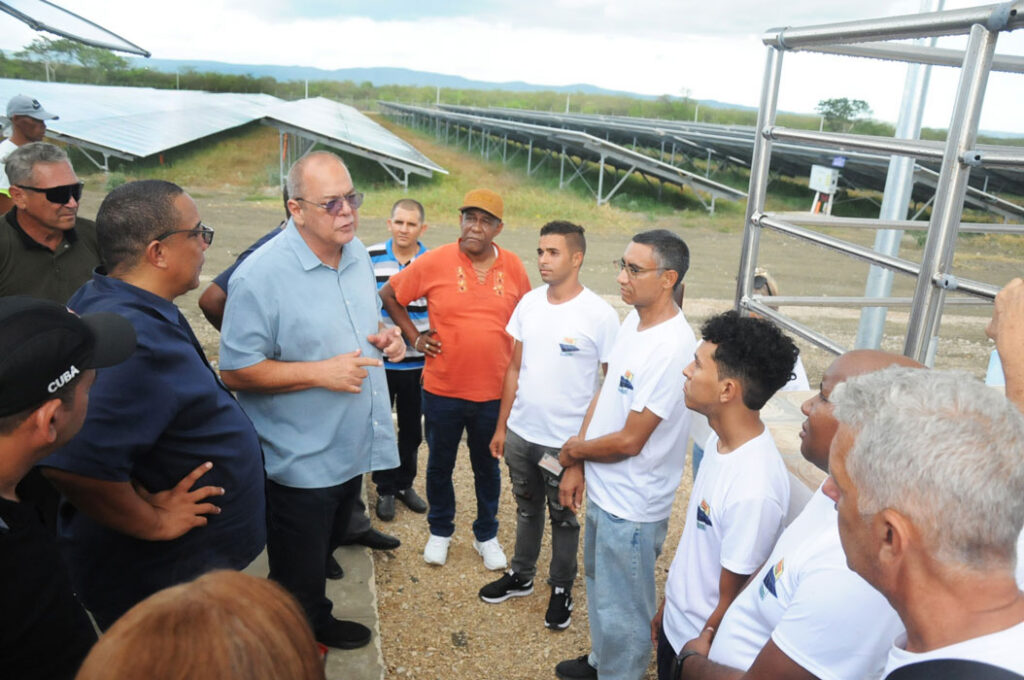
 Guantanamo.- The Minister of Energy and Mines speaks with talented young people during a visit to the El Algarrobo photovoltaic park, located on the road to Baracoa. With two months left before 2026—for many, the most difficult year of the Cuban Revolution—comes to an end, the period is marked by an intensification of the U.S. government’s six-decade-long commercial and financial blockade against the island, compounded by numerous executive orders and measures from the Trump administration aimed at strangling the Cuban economy.
This unfavorable landscape is palpable in the form of endless blackouts, difficulties in accessing basic services, and a wide array of limitations and shortages. Nevertheless, Cuba remains committed to advancing its energy transition and implementing the economic and social transformations essential for driving the country’s development for the benefit of its population.
The National Strategy for Energy Transition in Cuba—approved and published in the Official Gazette of the Republic in September 2024—seeks to shift the energy mix away from a reliance on fossil fuels toward renewable sources for electricity generation, primarily solar, wind, and hydropower.
Currently, Guantánamo province boasts an installed capacity of 173.34 MW, contributing to the National Electric Power System (SEN). This capacity includes 12 solar parks generating 73.0 MW, distributed generation plants producing 95.62 MW, 1.7 MW from mini-hydroelectric facilities, and an additional 3.0 MW from biomass sources.
As part of the Government Program aimed at transitioning the energy matrix, the region is actively investing in renewable energy initiatives that benefit economic and social service centers, rural communities, isolated homes, multi-family residential buildings, and public lighting.
To date, there are 17,115 clients, comprising both state and private entities, utilizing installed photovoltaic solar panels. Efforts are underway to achieve full generation capacity at the San Pedro II and El Peral solar photovoltaic farms. Furthermore, a 2.2 MW installation in Jesús Lores and a mini-farm in Yacabo Arriba, both situated in the municipality of Imías, are expected to be completed by the end of the year.
During a recent visit to the province, Vicente de la O Levi, Minister of Energy and Mines, commended Guantánamo’s advancements in the energy sector. He emphasized the importance of these developments in the context of the country’s broader Economic and Social Transformations.
The Minister underscored that all measures and actions must prioritize the economic development of the territories while fundamentally delivering social benefits. He emphasized the need to move beyond complacency and transition from mere resistance to proactive development.
De la O Levi further articulated that changes should not be implemented for their own sake; rather, the primary criterion for reforms in the electricity sector should be the tangible benefits to the population, such as minimizing power outages, enhancing access to cooking gas, ensuring a reliable fuel supply, and improving the organization and management of mining operations.
The energy and mining sectors are crucial for the nation’s vitality and the sustainability of the Cuban social project, with a strategic focus on supporting the workforce and mitigating the loss of skilled professionals. At the end of the year, Guantánamo’s companies in this sector reported a labor turnover rate of nearly nine percent, which, although lower than in other provinces, still requires careful examination.
These organizations possess full autonomy in making decisions related to salaries, resources, staffing, and profits. Additionally, managers are empowered to advocate for their employees, enhancing job appeal and aiding in the retention of a specialized workforce that cannot be developed overnight.
As these transformations unfold, the sector must also address crime, particularly theft, which poses a significant challenge in Guantánamo and requires urgent attention. The Minister called for an end to the theft of solar panels, bolts, and components from photovoltaic plants, as well as oil from transformers—crimes that deprive communities of electricity and essential services, causing considerable frustration among the hardworking populace.
