
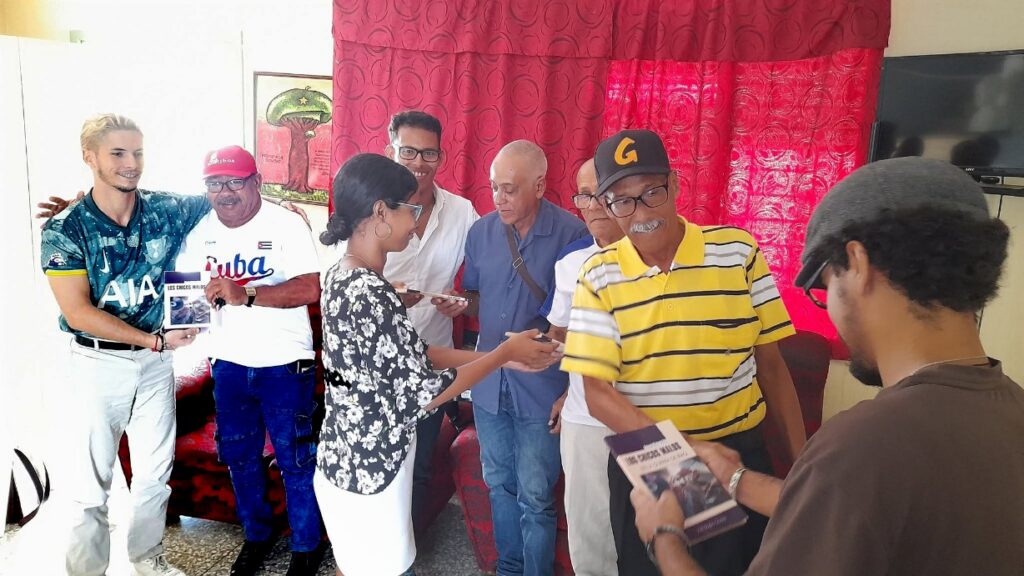
Guantánamo.- International Journalists’ Day, observed on September 8 in honor of Julius Fučík—a Czechoslovak journalist murdered by Nazi forces during World War II—was commemorated in Guantánamo with an intergenerational exchange between young reporters and veteran journalists who had participated in internationalist missions.
Leonel Escalona Furones, Antonio Marrero Duverger, and Ariel Soler Costafreda—all recipients of the José Vázquez Savón Provincial Journalism Award for Lifetime Achievement—as well as José Llamos Camejo, “Granma”’s correspondent in Guantánamo, shared professional experiences from their work in countries across Africa, Asia, and Latin America.
The event was held at the headquarters of the Guantánamo provincial branch of the Union of Cuban Journalists. There, the veteran reporters exchanged experiences and shared lessons learned while working abroad in environments shaped by different cultures and specific historical circumstances, including war, illiteracy, poor sanitation, poverty, and neglect—conditions that threatened to undermine Cuban solidarity and internationalism.
Soler Costafreda, of the “Venceremos” media outlet, recalled his time in the People’s Republic of Angola from 1980 to 1981, when he served on the “Verde Olivo” team as part of an internationalist mission. The Cuban Journalists Association had assigned him to report on the daily work of the thousands of Cubans providing medical, educational, construction, and other services in the land of Agostinho Neto.
Despite the war waged by Jonas Savimbi’s UNITA, backed by South Africa from the south; the FNLA, led by Holden Roberto and supported by Zaire from the east; and the FLEC in the Cabinda enclave to the north, the spirit of collaboration and internationalism among the Cuban civilian mission and its journalists never wavered. Braving danger, they traveled throughout the provinces, producing daily broadcasts of “La Hora en Español” for Angola’s National Radio, as well as the weekly newspaper “Verde Olivo en Misión Internacionalista.”
Escalona Furones, representing the provincial Party leadership in Guantánamo, shared memories of his time as a war correspondent in the RPA. He witnessed the massacres and ruthless actions carried out by the factions of the misnamed National Union for the Total Independence of Angola (UNITA). He also emphasized the importance of the military training he received before embarking on what he described as a sacred mission—one he remembers with pride.
Marrero Duverger—then a journalist for Radio Rebelde in Cuba’s easternmost region and for CMKS, Trinchera Antimperialista (Anti-Imperialist Trench)—recounted his experiences as a war correspondent in Ethiopia.
He was followed by Llamos Camejo, who shared compelling stories from his work in Venezuela and Haiti, as well as from his visits to Vietnam. He traveled to that country twice while researching his book, “Fidel, un guerrillero antillano en el paralelo 17” (Fidel, an Antillean Guerrilla at the 17th Parallel), which chronicles the Commander-in-Chief’s visit to Vietnam during the height of its war of liberation.
