
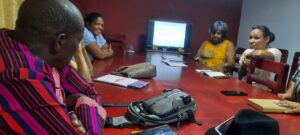
Guantanamo.- “Reclaiming Memory: History of Community Sociocultural Projects in Guantánamo” was the title of the lecture-workshop given by Marlen Zulima Pérez Veriel, Master of Science and specialist at the “Sócrates Villalón” Center for Cultural Development.
She shared her experiences in systematizing these initiatives, which have a positive impact on the quality of life of Guantánamo residents.
The main objective of the workshop was to identify and evaluate the contributions of these projects to the social and cultural development of the region. Managers of prominent initiatives, such as “Artesanato con Yeni,” “Lakou Lwa,” and “Cultura y Longevidad,” among others, were invited to discuss the limitations and strengths they have faced throughout their development.
“I believe the greatest impact of these projects lies in the commitment shown by the various leaders in each of the communities where they operate, as well as in the resilience of the project managers in Guantánamo,” stated Marlen Zulima Pérez Veriel, host of the program, speaking in the meeting room of the Provincial Directorate of Culture.
Among the lessons learned, the commitment of community leaders and their resilience in the face of financial and resource adversity were highlighted. These challenges are essential for the expansion of long-standing initiatives like the Guantánamo-Baracoa Theater Crusade, which emerged in 1989 amidst economic hardship in Cuba.
One example mentioned was the community of Raposo, in the city of Guantánamo, which has undergone a remarkable transformation thanks to projects such as Príncipe Enano, El Garaje, and La Caoba.
The importance of providing cultural support and guidance from government institutions to the most vulnerable neighborhoods was a vital theme during the debate, which underscored the need to continue promoting actions that foster cohesion and community development.
