
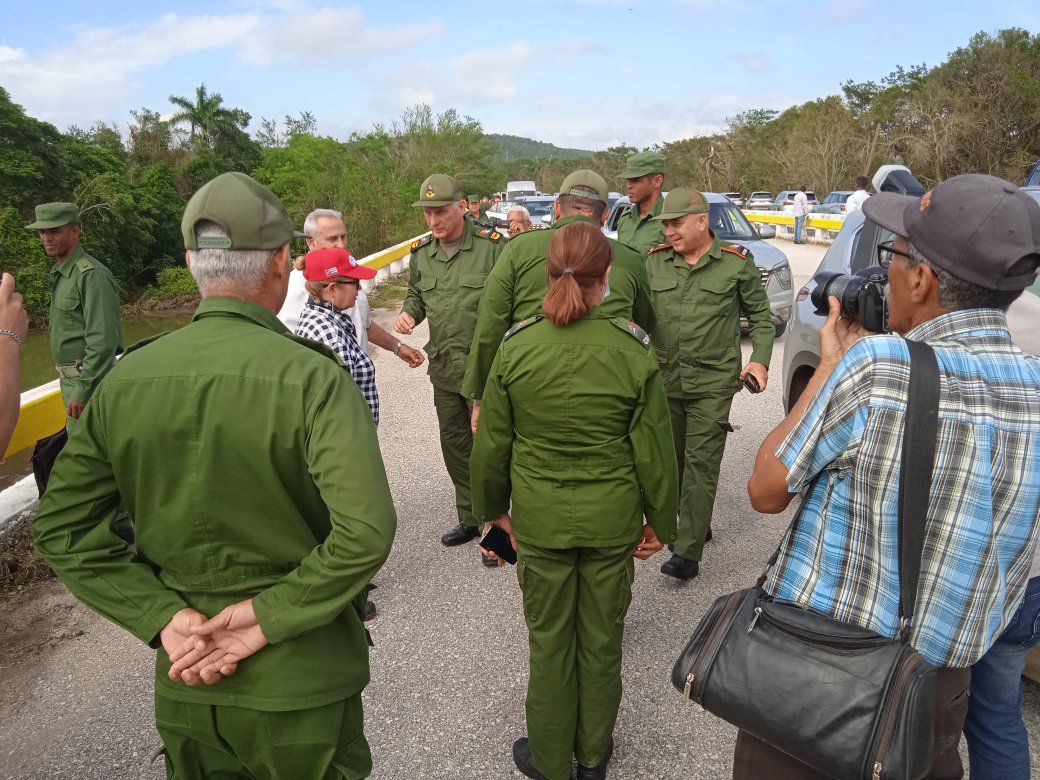
 Guantánamo – The President of the Republic of Cuba and First Secretary of the Central Committee of the PCC, Miguel Díaz-Canel Bermúdez, visited Guantánamo today to assess the damage caused by the intense rains from Tropical Storm Melissa and to promote the province’s swift recovery.
During his tour, he was accompanied by Roberto Morales Ojeda and the heads of several ministries, as well as the First Secretary of the Party in Guantánamo, Yoel Pérez García, and the governor, Alis Azahares Torreblanca.
He visited the GEYSEL facility, a company dedicated to the maintenance of power generators. It was reported that the province generates 13 megawatts of electricity, although currently only 9 are being supplied due to several damaged circuits.
The eastern municipalities of the province are the least affected, but downed power poles are preventing an immediate restoration of service. It is expected that electricity will be restored in most areas this week, although some areas, such as the city of Guantánamo and the municipality of Caimanera, may take longer. In this context, the availability of fuel for the power generators was guaranteed.
Díaz-Canel acknowledged Guantánamo’s extensive experience in generating electricity through an islanded system and thanked the workers of the electric company for their efforts to restore service.
The president also inquired about the impact of the rains in various localities, including Manuel Tames and Yateras, where many homes were damaged.
The La Yaya dam, which reached 165 million cubic meters, has begun releasing water at a rate of 200 cubic meters per hour, something that had not happened since 2012. The dam’s overflow damaged the fiber optic cable, leaving the province without telecommunications service for more than 48 hours.
In addition, the road connecting the mountainous municipality of Yateras is experiencing landslides in the Loma de la Sierra area, affecting four towns. In terms of agriculture, damage to coffee, banana, and corn crops was highlighted. Díaz-Canel suggested protecting the cassava seeds and utilizing the water resources to increase rice planting, in addition to using the wood from the fallen trees.
He also acknowledged the rapid and effective evacuation carried out, as well as the discipline of the people of Guantánamo in the face of the emergency. These actions aim to guarantee a comprehensive and sustainable recovery in the region.
On October 29, Hurricane Melissa made landfall in Cuba at 3:10 a.m. local time as a Category 3 storm, with maximum sustained winds near 120 mph (195 km/h) and a central pressure of 952 mb.
In Guantánamo, 152,181 citizens were protected, representing 34% of the province’s population, including a total of 40,911 families.
The rain associated with this weather event increased the water level in the reservoir system by 85.4% in less than 12 hours. The La Yaya dam, the largest in the territory, reached its maximum capacity, releasing 200 m³/s.
Very high rainfall totals were reported in the municipalities of Caimanera with 157 mm; Niceto Pérez, 107 mm; and San Antonio, 101 mm.
