
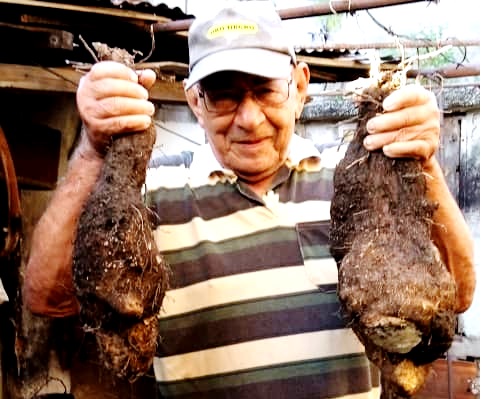
 Guantanamo.- Isaías Velázquez, formerly a farmer from Tribilín, in the municipality of Yateras, and a resident of Guantánamo City for several decades, hasn’t forgotten his land surveyor roots. In his small backyard, he grows, among other things, delicious yams for his family each year.
The flavor and size of the yam make it an attractive tuber for human consumption. It has a low fat content and a high fiber content, which contributes to a healthy diet.
According to Dr. Misterbino Borges García, from the University of Granma, a compiler of traditional recipes still valid today. He asserts that there are more than 30 types of dishes made with this staple tuber vegetable.
Yam contains small amounts of vitamin-A, and β-carotene levels as well as complex carbohydrates in the form of starch, as well as iron, zinc, calcium, copper, manganese, and potassium, among other nutrients.
With all these components, this root vegetable becomes a useful food for helping to control blood pressure, arthritis, and other circulatory diseases.
Yam can be used to make croquettes, arepas, fritters, fritters, balls with parsley cream, fufu, purée (to which seasonings can be added), empanadas, bread, tortillas, and even flans, casseroles, and cookies, among other dishes.
Development programs for obtaining and propagating seeds, new production techniques, and the incorporation of more areas and producers into yam cultivation in the country can support the development and expansion of these traditional dishes in everyday consumption.
Santiago de Cuba, Granma, Guantánamo, and some central provinces are the regions with the highest consumption of this tuber and the strongest tradition of preparing dishes with yam.
The yam is an edible herbaceous plant belonging to the genus Dioscorea, of the Dioscoreaceae family, native to and common in tropical and subtropical regions worldwide. The genus Dioscorea is quite large; the most prominent species are Dioscorea alata (large yam or water yam), native to South Asia, Dioscorea cayenensis (yellow yam), and Dioscorea rotundata (white yam), both found in West Africa.
