
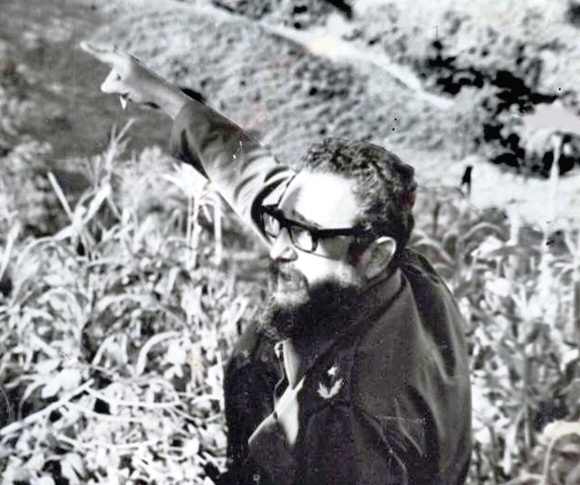
 Guantanamo.- From El Alto del Quimbuelo, Fidel outlined the economic and social development plans for the Caujerí Valley.
The afternoon of July 1, 1977, was coming to an end when the top leader of the Cuban Revolution, Fidel Castro Ruz, and a group of comrades reached the summit of El Alto del Quimbuelo, to enjoy the beauty of the Caujerí Valley from there and define strategies that would allow the agricultural, economic and social development of that southern territory of Guantánamo.
Located 60 kilometers east of the city of Guaso, the Valley is nestled in the easternmost mountain system of the country and geographically belongs to the municipality of San Antonio del Sur; it is a depression —not flat— in the middle of the confluence of high mountain ranges such as Purial and Imías, with more than a thousand meters of height and Caujerí, close to 500.
In reality, the Caujerí Valley is the basin of the Sabanalamar River, which in the few rainy periods present in the region, feeds its small tributaries from the surface runoff of the slopes of these mountains that face the hollow.
Flowing through fertile lands, many consider it an “oasis”, because it is located south of Guantánamo, an arid area known as the Cuban semi-desert.
There are several population settlements in this territory, among which stand out Guaibanó, El Corojo, Manguito, the Flores neighborhood and others scattered through hills and plains, up to Puriales de Caujerí, located further north.

The Commander-in-Chief met with farmers from the Caujerí Valley at the Guaibanó social club.
On July 1st and 2nd, 1977, Fidel toured and camped in the Valley, where he met with farmers at the Guaibanó Social Club, and urged them to establish Agricultural Production Cooperatives (CPA), participate in the rehabilitation of their damaged agricultural areas and in the economic and social development of the area.
An Agricultural Polytechnic Institute, a pre-university school in the countryside and primary schools; a polyclinic, family doctor offices, a Territorial Plant Protection Station, several communities where peasants and workers live, three CPA, five CCS, two UBPC, which together cover more than 105 caballerías, are some of the transformations carried out in the Caujerí Valley, 49 years after the visit of the Leader of the Revolution.
During this time, significant and costly investments were made, such as the Sabanalamar-Pozo Azul water transfer, primarily to alleviate the major water problem, increasing irrigation systems to potentially produce more than one million quintals of root vegetables, grains, and oother crops.
A factory for processing fruits and vegetables and covered growing houses, where healthy and high quality seedlings are achieved, which increase the production of the farmers of the region.
In the year of the Centenary of the Commander-in-Chief, making Fidel’s dreams of turning the Caujerí Valley into a true productive garden a reality is a special motivation for the farmers of Guantánamo.
