
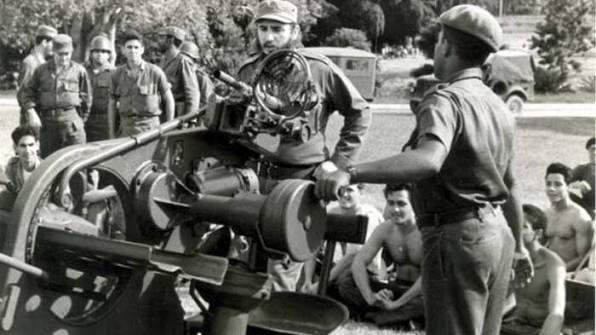
 Guantanamo.- On this day in 1962, the event known as the October Crisis, or the Missile Crisis, commenced, marking a pivotal moment when humanity faced the imminent threat of nuclear war for the first time. In this tense atmosphere, Cuba asserted its commitment to safeguarding its sovereignty against the United States, which was under the leadership of President John F. Kennedy, who had initiated a naval blockade against the island nation.
The roots of this perilous situation can be traced back to the earlier deployment of Soviet troops in Cuba, a decision made under a bilateral agreement between the two countries, which included the installation of medium-range nuclear missiles capable of striking U.S. territory. This significant development went unrecognized by political leaders in the United States, leading to Cuba maintaining a heightened state of combat readiness from October 22 to October 28.
In response to military activities observed in the southern United States, such as the repositioning of anti-aircraft systems and the bolstering of the illegal naval base at Guantánamo, Cuba declared its preparedness to counter any acts of aggression. Under the leadership of Commander-in-Chief Fidel Castro, the nation stood resolute, fully aware that it was defending its fundamental right to independence.
At that time, the threat of a surprise air strike was escalating, exacerbated by an uptick in low-altitude flights over Cuba. In response, Fidel Castro decided to authorize the shooting down of any aircraft that breached Cuban airspace, effective from dawn on October 27.
Meanwhile, discussions between President Kennedy and Nikita Khrushchev, Chairman of the Soviet Union’s Council of Ministers, occurred without Cuba’s awareness. In this context, the Commander-in-Chief articulated his well-known “Five Points,” asserting that the guarantees mentioned by Kennedy would only be valid if, in addition to the promised lifting of the naval blockade, the following conditions were met:
The cessation of the economic blockade and all forms of commercial pressure from the United States against Cuba; the termination of subversive activities, including the delivery of weapons, mercenary invasions, espionage, and sabotage; an end to pirate attacks; a halt to all violations of Cuban airspace and territorial waters by U.S. military forces; and the withdrawal from Guantánamo Naval Base along with the return of occupied Cuban territory.
However, American leaders dismissed these five points as an unrealistic agenda at that time.
As the conflict intensified, the UN Security Council convened on October 23 to hear the perspectives of representatives from the three involved nations. The Cuban representative asserted that the country had been forced to arm itself for self-defense, emphasizing that this did not pose a threat to the United States. Additionally, a document was submitted outlining the acts of sabotage, piracy, and terrorism perpetrated against Cuba.
After extensive discussions, which included participation from Acting UN Secretary-General U Thant, the Soviet missile sites were dismantled in late October as a result of negotiations between Khrushchev and American officials, conducted without Cuban leadership’s involvement.
Throughout various critical moments in the Revolution’s history, Cuban diplomacy, under Fidel’s guidance, proved to be remarkably effective.
Ernesto “Che” Guevara, in his farewell letter, reflected on the Commander-in-Chief’s pivotal role during the October Crisis, stating, “I have lived through magnificent days, and by your side, I felt the pride of belonging to our people during the bright yet somber days of the Caribbean Crisis. Rarely has a statesman shone more brilliantly than during those days.”
