
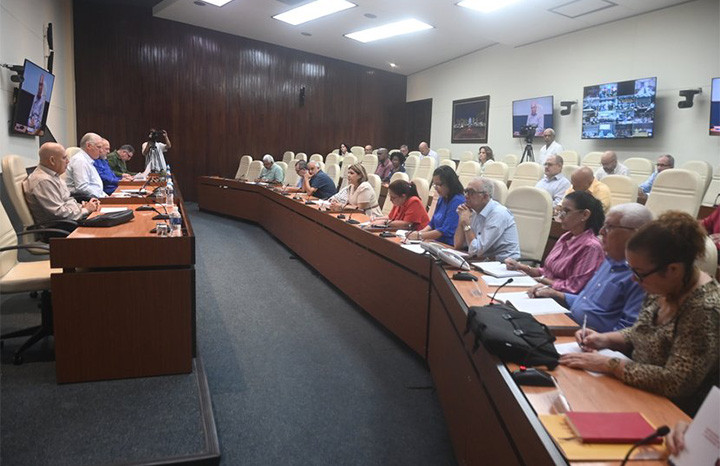
 Guantánamo.- Miguel Díaz-Canel, First Secretary of the Central Committee of the Communist Party of Cuba (PCC) and President of the Republic, today presided over the launch of the Sixth National Exercise to Prevent and Combat Crime, Corruption, Drug-Related Offenses, Illegal Activities, and Social Indiscipline.
According to an announcement on the Presidency’s official website, the initiative runs from November 23 to December 5 and focuses on strengthening measures to promote stability and public safety. It aims to advance social well-being and address economic distortions amid the complex circumstances facing Cuba, which the announcement attributed to an intensifying blockade, an energy siege, and the threat of imperialist aggression.
Díaz-Canel reviewed trends in the various problems affecting Cuban society, including the emergence of new forms of crime. He said many are encouraged by the enemy in an effort to destabilize the country and create a sense of insecurity. The president emphasized that addressing these issues is also an integral part of ongoing economic and social transformations, which prioritize social justice and tackling vulnerabilities.
The meeting was held both in person and virtually. Participants included members of the Political Bureau: Prime Minister Manuel Marrero Cruz; Roberto Morales Ojeda, Secretary of Organization of the PCC Central Committee; and Interior Minister Corps Gen. Lázaro Alberto Álvarez Casas. Other leaders from the Party, the State, the government, mass organizations, and the Young Communist League also attended. Julio César García Rodríguez, a member of the PCC Central Committee and head of the Office for Oversight of the Organs of People’s Power, was also present.
The program includes community-based exchanges with people who are neither studying nor working, as well as discussions about drugs in neighborhoods and organizations. It also aims to promote and strengthen the efforts of Party militants, trade unions, and youth organizations to prevent and address these issues. In addition, it supports the participatory movement My Neighborhood for the Homeland (Mi Barrio por la Patria), particularly its Safe Neighborhood (Barrio Seguro) initiative, and features a broad communications campaign.
According to the report, Cuba’s prime minister stressed on Monday the need to give special attention to exploitative and speculative pricing. He said the problem cannot be resolved simply by imposing price caps; instead, authorities must engage directly with economic actors.
He called for dialogue with these actors to discuss the issue and clarify when their conduct constitutes misconduct—in particular, violations of price regulations. He also raised concerns about tax evasion, high prices in neighborhood markets, and the refusal to accept bank transfers.
Meanwhile, Roberto Morales Ojeda, secretary of organization of the Central Committee of the Communist Party of Cuba (PCC), emphasized the importance of implementing the program through structures originally established for wartime but now activated in peacetime.
