
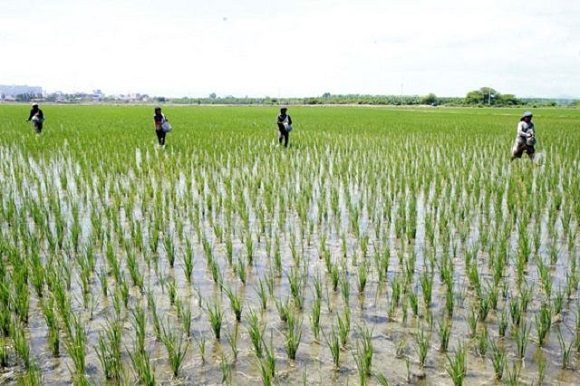
 Guantanamo.- The Enrique Campos Caballero Credit and Services Cooperative (CCS, in Spanish abbreviation), in La Jabilla settlement, is consolidating its position as a strategic production hub for Guantánamo’s rice program.
The cooperative currently has 120 hectares devoted to rice cultivation and aims to expand that area to 200 hectares next year.
It was confirmed during a tour of four local production areas by Yoel Pérez García, First Secretary of the Communist Party of Cuba in Guantánamo Province, accompanied by officials from the agricultural and provincial banking sectors.
The visit sought to assess progress in agriculture and examine the challenges facing farmers in their development efforts.
At the Enrique Campos cooperative, President Heriberto Martín Campos explained that the organization has a total area of approximately 2,743 hectares, of which 1,754 hectares are currently under cultivation or used for livestock production.
He noted that 17 hectares are currently planted with rice under an agreement with a micro, small, and medium-sized enterprise (MSME), with plans to increase that area to 40 hectares.
Another 36 hectares are being cultivated with the cooperative’s own resources. In addition, a loan is being processed for a producer with 42 hectares of land awaiting land clearance.
Martín Campos added that the cooperative has 250 members, including 176 landholders, and is actively working to attract young people and women to ensure the organization’s long-term sustainability.
The cooperative produces plantains, *burro* bananas, cassava, sweet potatoes, grains, and cool-season vegetables such as peppers, tomatoes, and cabbage. It also produces honey. In addition, it is expanding into sheep and goat farming to obtain milk for social programs and produce cheese as a value-added product.
During the tour, officials also highlighted the positive example of La Sombrilla, located in the Arroyo Hondo–Paraguay area of the municipality of Guantánamo.
The lush rice fields demonstrate that the land is well suited to the crop. The area currently has 25 hectares planted with rice, with plans to extend cultivation toward the Paraguay road by an additional 10 hectares—an example that shows progress in grain production is achievable.
At the Caimanera production hub, which has 60 hectares of arable land devoted to various crops, producers of beans, corn, sweet potatoes, cassava, and tomatoes reviewed the factors affecting output.
The main difficulties identified were problems with the irrigation system and a shortage of bean seeds. In response, officials instructed producers to seek domestic alternatives and verify the quality of the seeds expected to arrive through the Mexican project.
At the Grain Enterprise in Niceto Pérez, located approximately 20 kilometers from the provincial capital, officials discussed several concerns.
These included the need for an energy schedule that would guarantee more than two hours of daily pumping for irrigation, the purchase of fuel through bank transfers, the acquisition of agricultural inputs, and delays in obtaining loans for the cool-season planting cycle.
Authorities indicated that these issues must be resolved as soon as possible.
