
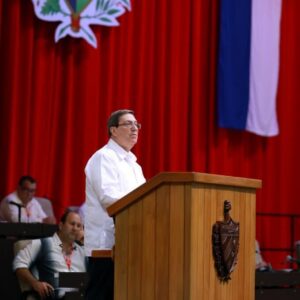
 Foreign Minister Bruno Rodríguez Parrilla warned the National Assembly on Wednesday that the international context in which Cuba defends its sovereignty has worsened significantly due to the intensification of U.S. actions and the weakening of the principles of international law. During his address to Parliament, the Foreign Minister denounced Washington’s choice to disregard the Charter of the United Nations and impose its will through intimidation, coercion, and unilateral measures.
Rodríguez Parrilla warned of the resurgence of McCarthyism in the United States and rejected a State Department report that attempts to portray Cuba as a threat to U.S. security. The Foreign Minister called the document superficial, false, and inconsistent, and denounced its purpose as criminalizing expressions of solidarity with the archipelago, questioning its right to defend its sovereignty, and discrediting the internationalist work the country has carried out for decades.
The minister denounced Washington’s intensified economic war against Cuba, its reinforcement of the energy blockade, its obstruction of trade relations with third countries, and its attempts to isolate the nation from the international economy. He rejected claims that the blockade does not exist and maintained that this policy constitutes a violation of the sovereignty of Cuba and other states, directly affecting access to food, medicine, fuel, and supplies for electricity generation.
Despite this complex scenario, Rodríguez Parrilla emphasized that the Caribbean nation maintains broad relations of friendship, cooperation, and respect with the vast majority of countries in the world. As evidence of international rejection of the blockade, he pointed to the vote of 136 countries to nine that, on July 7th at the UN General Assembly, rejected the US attempt to prevent debate on this policy.
The Foreign Minister reaffirmed the Cuban government’s willingness to engage in respectful dialogue with the United States based on sovereign equality and mutual respect; however, he stated that Washington continues to prioritize coercion and unilateral measures. He emphasized that Cuba poses no threat and reiterated the country’s commitment to peace, in accordance with the Proclamation of Latin America and the Caribbean as a Zone of Peace.
Rodríguez Parrilla evoked the legacy of Commander-in-Chief Fidel Castro, stating that in the year of his centennial, it is essential to understand his conviction that “a better world is possible.” He recalled that Fidel always defended a more just international order, free from “cruel blockades that kill men, women, and children like silent atomic bombs,” and maintained that this vision fuels the certainty of victory.
The President of the National Assembly of People’s Power (ANPP), Esteban Lazo Hernández, acknowledged the work of the Ministry of Foreign Affairs and the Cuban diplomatic service, especially given the difficult circumstances facing the country. He expressed his appreciation for the loyalty, steadfastness, and commitment of Cuban diplomats to defending the principles of the Revolution and the truth about Cuba in diverse international arenas.
Source: RHC
