
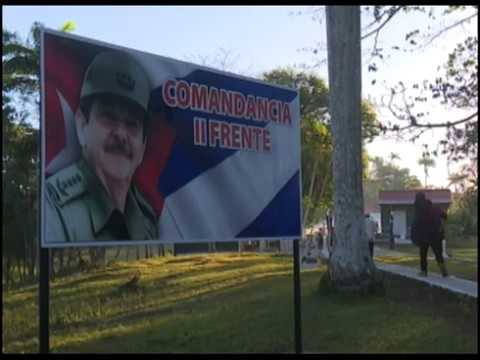
 Guantánamo.- The morning of March 26, 1958, dawned in the Monte Rus mountain range with the characteristic stealth of war. Then-Commander Raúl Castro Ruz, demonstrating the expertise acquired through the harsh lessons of the Sierra Maestra, decided to establish the First Command Post in the middle of a coffee plantation known as El Aguacate.
The choice of location was a masterstroke. Situated 30 kilometers in a straight line from the city of Guantánamo—the main enemy stronghold—and 27 kilometers from Sagua de Tánamo, the site was a geographical powerhouse.
It was a point of convergence between coffee-growing regions, mining areas, and sugar-producing valleys, with a natural infrastructure that would allow for the settlement and supply of troops. But Raúl wasn’t just looking at the present; he was looking at history.
In that same location, during the Ten Years’ War, Generals Máximo Gómez and Antonio Maceo had established their base of operations during the invasion of Guantánamo, a place that Brigadier Arsenio Martínez Campos was never able to wrest from them.
Weighed down by that foundational history, the command post was formally established in a large house belonging to a local widow.
It was a day of multiple foundations. Not only was the rebel leader’s tent pitched there, but two decisions were made that would shape the course of the front.
First, the creation of the Rebel Intelligence Service, vital for tracking the enemy’s movements. Second, the design of Operation Omega, a plan of coordinated attacks to support the General Strike called for April, which would include battles in Jamaica, Caimanera, the Caribe neighborhood, and the Soledad sugar mill.
That same day, Raúl Castro decided to delegate command of the newly established command post to his second-in-command, Captain Efigenio Ameijeiras Delgado, who would be promoted to Commander a few days later, on April 4. Raúl, as a strategist, would continue to move among the four command posts of the front, but El Aguacate would be forever remembered as the “historic Command Post.”
The stronghold was soon put to the test. Shortly afterward, the bulk of the tyranny’s offensive was launched against this location. Batista’s generals assumed that the heart of the rebellion lay there. Armored columns supported by air power attempted to encircle El Aguacate from the east, south, and west in an offensive aimed at eliminating the front. But as in Maceo’s time, the mountain defended itself.
The rebel forces mounted a tenacious resistance at Cabeza de Negro, Gurugú, and La Tinaja, where fighters like Sixto Acosta and Tomás Eloy Méndez fell.
The enemy tanks became bogged down in the Paso de la Mariposa gorge, mined by the rebels, and never managed to get within ten kilometers of the command post. By the end of June, the Batista command had to retreat in defeat.
Sixty-eight years after that March day, El Aguacate de Monte Rus is not just a point on the map of the municipality of El Salvador. It is a symbol of how historical expertise and knowledge of the terrain combined to forge one of the pillars of liberation in the eastern region.
In the middle of the jungle and coffee plantations, on that March 26, the legend of the impregnability of the Second Eastern Front “Frank País” began to be written.
